Loading
MFG · Subsurface H2
A controlled, scalable engineered process that activates natural reactions in iron-rich rock formations — producing hydrogen directly underground.
The Process
Three deliberate steps. Familiar oil & gas hardware. Validated geochemistry. The Earth provides the reactor — we provide the recipe.
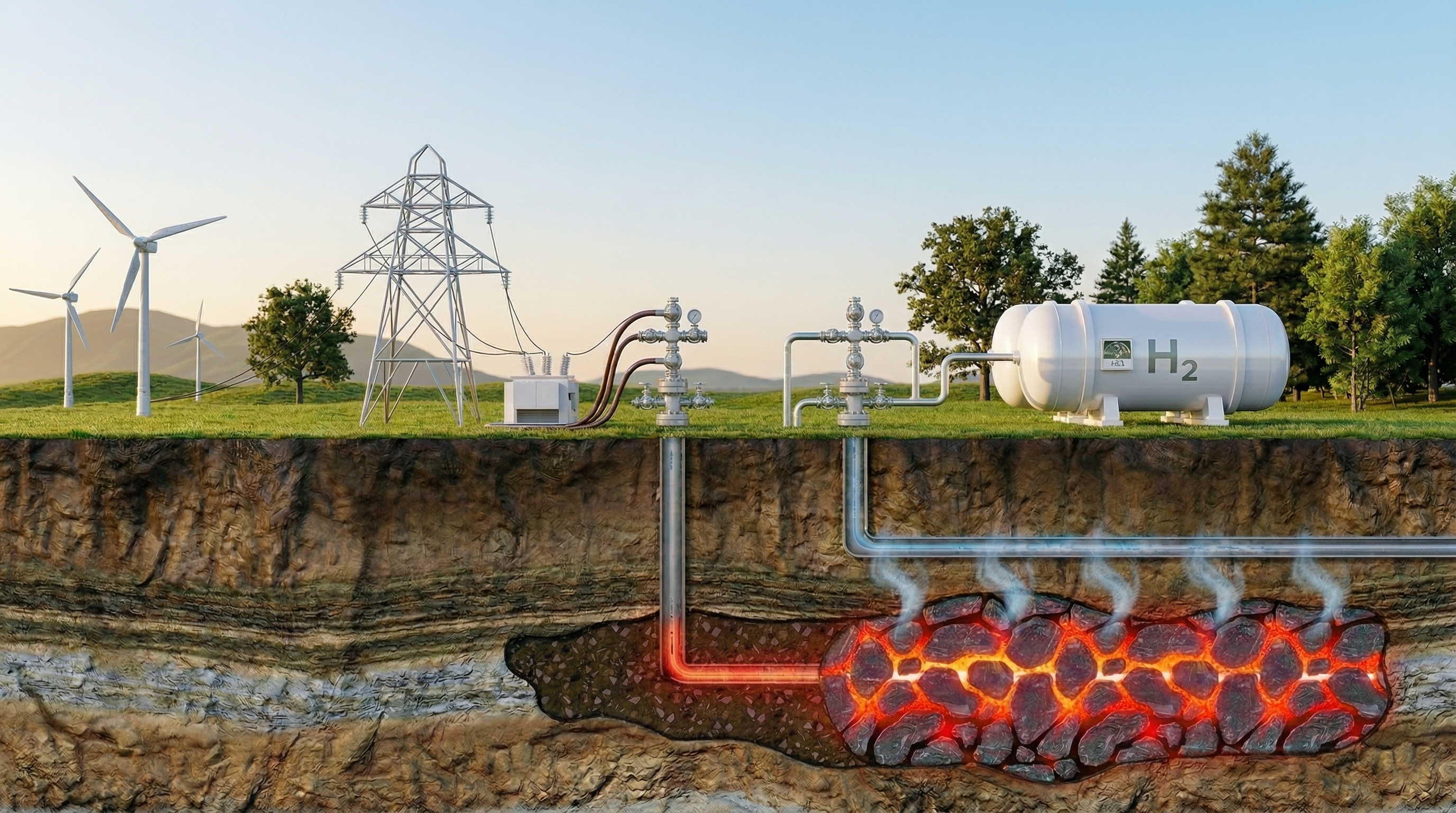
Electric heaters are placed directly into iron-rich rock formations, below the surface. High-power subsurface heaters deliver targeted, uniform heat fronts.
Targeted heat triggers natural geochemical reactions — serpentinization — that generate hydrogen in place. Reaction rate scales exponentially with temperature.
Pressure gradients drive hydrogen to the producer well, where it’s collected at the surface. No fracking. No added water. No surface reactor.
The Concept
A heater well delivers controlled heat into iron-rich rock. The rock reacts. A producer well collects the hydrogen. Renewable electricity in — clean hydrogen out.
Why MSSH works
A controllable, manufacturable, energy-positive product — built on technology the energy industry already understands.
Seamlessly integrates with renewable electricity sources to enhance sustainability.
Strategic well placement and spacing maximize energy use and hydrogen collection efficiency.
Leverages established technologies, including cost-effective horizontal wells and high-power subsurface heaters for efficient and scalable performance.
MSSH requires only ~15 kWh/kg H2 — outperforming green hydrogen at 55 kWh/kg H2.
Heat propagates with relatively uniform front. Serpentinization rate exponentially depends on temperature. Targeted heat delivery creates pressure gradients that drive products to the producer well.
The Module Advantage
MSSH is delivered as repeatable production modules that can be sized to demand and chained together — with each module producing a stable rate over time, far flatter than a conventional decline curve.
Module size enables reliable field production rates tailored to demand.
MSSH delivers consistent rates, avoiding decline curves seen in conventional fields and ensuring efficient use of surface facilities.
Supports intermittent power supply, stabilizing grid demand and optimizing costs.
Requires only 50 MW vs 200 MW for electrolysis to generate 30 kta H2.
Does not rely on fresh water supply.
Matches or outperforms green hydrogen with significantly lower cost.
The Hydrogen Potential
Hydrogen demand is growing rapidly — driven by industry, mobility, and energy systems. But today's production methods face real constraints: high cost, high energy use, and limited scalability.
GeoKiln introduces a new pathway — manufacturing hydrogen directly from the Earth. Low-cost. Scalable. Geology-led.